
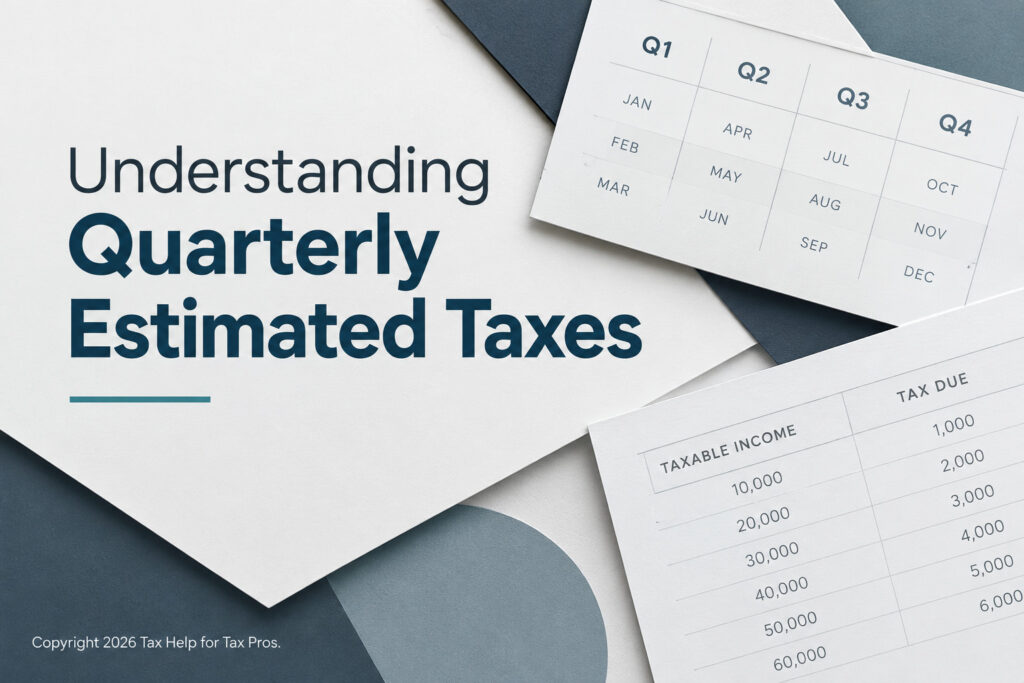
Quarterly Estimated Taxes
If you’re self-employed, run a small business, or operate as an independent contractor, there’s a good chance you’re required to make estimated payments throughout the year.
Understanding Why Estimated Taxes Exist
In a traditional job, your employer withholds taxes from each paycheck and sends them to the IRS on your behalf. But when you’re self-employed or own a business, there’s no automatic withholding. That means it’s up to you to set aside and pay taxes throughout the year. This is where estimated tax payments come in.
The U.S. tax system operates on a “pay-as-you-go” basis, and the IRS expects you to make payments on your income as you earn it. Waiting until the end of the year to pay your full tax bill can lead to penalties, even if you pay the correct amount when you file your return.
Who Needs to Make Estimated Tax Payments?
If you expect to owe at least $1,000 in taxes when you file your return, you’re likely required to make estimated payments. This applies to anyone earning income that isn’t subject to withholding, including sole proprietors, LLC owners, freelancers, independent contractors, landlords, and investors. It also applies to S corporation shareholders who receive pass-through income.
If you fall into any of these categories, you’ll need to keep up with estimated payments or risk late payment penalties and interest.
When Are Quarterly Taxes Due?
Estimated tax payments are made four times a year, spaced out roughly every three months. For most taxpayers, the deadlines fall on April 15, June 15, September 15, and January 15 of the following year. If a due date falls on a weekend or federal holiday, it rolls over to the next business day.
Each payment covers income earned during a specific portion of the year, but you don’t have to wait until the quarter ends to send in your payment. You can pay early or more frequently.
How to Calculate Your Estimated Taxes
There are two main ways to calculate your quarterly estimated payments: the Safe Harbor Method and the Current Income Method.
The safe harbor method is a straightforward way to avoid penalties. If your income is relatively consistent from year to year, you can simply pay 100% of your prior year’s total tax liability, divided into four equal installments. (If your adjusted gross income was over $150,000, you’ll need to pay 110% instead.) This method guarantees that you won’t be penalized, even if your current year’s income ends up being higher.
The current income method involves estimating your actual income and expenses for the current year. This approach can be more accurate, especially if your income fluctuates throughout the year. To calculate your payment, estimate your net income, then apply self-employment tax (15.3%) to 92.35% of that figure. Then calculate your income tax based on your projected tax bracket and total the two amounts. Divide by four to determine your quarterly payment.
For example, let’s say you expect to earn $80,000 in net income for the year:
- Step 1: $80,000 × 92.35% = $73,880
- Step 2: $73,880 × 15.3% = $11,312 (self-employment tax)
- Step 3: Estimate income tax ≈ $8,500
- Step 4: Total estimated taxes = $19,812 ($11,312 + $8,500)
- Step 5: Divide by 4 = $4,953 per quarter
How to Make Payments (Including Illinois Requirements)
Federal payments can be made via:
- IRS Direct Pay
- EFTPS (Electronic Federal Tax Payment System)
- By mailing a check with Form 1040-ES
Online payments are preferred for speed and confirmation tracking.
If you live in Illinois, you may also need to make state estimated tax payments if you expect to owe more than $1,000 in Illinois income tax (after credits and withholding).
Illinois payments can be made:
- Online via MyTax Illinois
- Or by mailing Form IL-1040-ES with a check or money order
State estimated payments are generally due on the same quarterly schedule as federal taxes. Be sure to save all confirmations for your records.
Common Mistakes to Avoid
Some of the most common mistakes I see include underestimating self-employment tax, missing a quarterly deadline, or forgetting to adjust estimates for seasonal income changes. Others assume their tax software is handling it automatically, only to discover too late that it wasn’t set up properly.
The key is staying organized and setting calendar reminders for each due date. It also helps to set aside a percentage of each payment you receive—say, 25% to 30%, so that the funds are ready when it’s time to make your quarterly payments.
Final Thoughts from a Tax Professional
If you’re not sure how much to pay, or if you’d rather not spend time crunching the numbers yourself, this is exactly where a tax professional can help. I work with business owners year-round to help them project income, calculate quarterly payments, and avoid missteps that lead to stress or penalties down the road.
If you’d like help estimating your quarterly payments or building a tax strategy that fits your business, reach out. A little planning now can save a lot of headaches later.